Why Your Truck Passed Last Year But Failed This Year, and Nothing Changed
 Matt Brandt
Jun 16, 2026
Matt Brandt
Jun 16, 2026
Summary-
A failed commercial vehicle emission test does not always mean something broke overnight. Standards tighten, components wear quietly, and small issues that were borderline last year can tip over the line this year. This summary covers the real reasons trucks fail inspections after previously passing, and what operators can do to stay ahead of them.
The Test Did Not Change. The Threshold Did.
Truck owners get frustrated when a vehicle that sailed through its last inspection comes back with a fail. The engine runs fine. No warning lights. No obvious smoke. Nothing feels different. So what happened?
The short answer is that emissions testing is not a static benchmark. Standards get updated, testing equipment gets more sensitive, and what was considered acceptable opacity or a clean OBD reading one year may not hold up the next.
The DriveON program, which now governs commercial vehicle inspection in Ontario, has been progressively tightening how inspections are conducted. Trucks built in 2011 or later face stricter smoke emission thresholds than older vehicles, and even a minor exhaust issue that would have been overlooked before can now result in a straight fail.
The program's evolution is not the only reason. Diesel engines wear, filters load up, and systems that were working on the edge of acceptable slowly drift out of spec. The truck feels fine because the driver is not the instrument doing the measuring.
Your DPF Is Not Immortal
The diesel particulate filter, or DPF, is the component responsible for trapping soot and fine particulates before they leave the exhaust stack. It does its job through repeated regeneration cycles, burning off accumulated soot using heat. Over time, the filter loses its capacity to regenerate fully, especially on trucks that spend a lot of time idling or doing short urban runs.
Here is the problem. A truck running frequent short-distance routes often never gets the exhaust temperature high enough to complete a proper passive regeneration. Soot builds up faster than it burns off. The filter starts restricting flow, backpressure climbs, and visible smoke increases. The opacity test picks that up immediately.
Operators often do not notice because the truck does not go into limp mode right away. It just quietly gets dirtier. Last year, the filter was at 60% capacity. This year, it is at 85% and the smoke output has crossed the threshold.
The OBD System Catches What You Cannot See
For vehicles from the 2007 model year onwards with a GVWR of 6,350 kg or less, the emissions inspection includes an on-board diagnostics scan. This is not just checking for a check engine light. The OBD system runs a series of readiness monitors covering the EGR system, the DPF, NOx sensors, and the SCR catalyst.
If any of those monitors have not completed a full drive cycle since the last code clear, the system flags an "incomplete" result. That is an automatic fail regardless of how clean the exhaust looks. This catches operators off guard constantly, especially after a repair shop clears a code close to inspection time, and the truck does not get enough driving in for the monitors to reset.
A commercial vehicle emission test in Ontario requires all readiness monitors to show complete. One incomplete monitor is enough to fail the inspection.
Common Components That Quietly Drift Out of Spec
Most test failures on trucks that were previously compliant come down to a handful of components. None of them fails dramatically. They degrade.
- EGR valve: Carbon buildup restricts movement over time, reducing the valve's ability to recirculate exhaust gases properly. A sluggish EGR valve raises combustion temperatures, increases NOx output, and can clog the DPF faster than normal.
- DPF pressure and temperature sensors: These sensors tell the engine when to initiate a regeneration cycle. A faulty sensor means the system cannot accurately read filter load, resulting in missed regenerations and soot accumulation.
- DOC (Diesel Oxidation Catalyst): The DOC sits upstream of the DPF and helps oxidize hydrocarbons before they hit the filter. A degraded DOC transfers more unburned fuel into the DPF, accelerating clogging.
- DEF system on SCR-equipped trucks: Low-quality diesel exhaust fluid or contaminated DEF breaks down the SCR catalyst gradually. NOx reduction efficiency drops, and the OBD system logs faults even if the driver never noticed anything wrong.
None of these failures announce themselves with a dramatic symptom. The truck keeps running. The issues sit below the surface until test day.
How to Avoid the Surprise Next Time
Waiting until renewal time to find out the truck has a problem is the most expensive way to manage compliance. A few straightforward habits make a real difference.
- Get the DPF inspected and cleaned on a set interval, not just when a warning light comes on
- Run the truck at highway speeds regularly to allow passive regeneration to complete
- Address fault codes immediately, even if the truck seems to be running fine
- Check DEF quality and fluid levels consistently on SCR-equipped vehicles
- Pull a pre-inspection OBD scan a few weeks before your renewal date to confirm all readiness monitors are complete
Giving yourself a few weeks of lead time before the renewal date means any issues found during a pre-check can be repaired, and the monitors can reset before the actual inspection.
Straight Answers to the Questions Operators Actually Ask
Q1: Can a truck fail an emissions test even if no warning lights are on?
A1: Yes. OBD incomplete readiness monitors will fail an inspection even with no active fault codes showing. This happens frequently after a recent code clear, where the truck has not completed enough drive cycles for all monitors to run. The check engine light being off does not mean the system has finished its self-checks.
Q2: What is opacity, and what is the pass threshold in Ontario?
A2: Opacity measures the density of visible smoke in the exhaust. The current standard under the DriveON program is 30% for most heavy-duty diesel vehicles. Trucks scoring 20% or below may qualify to skip the following test cycle. Even minor exhaust issues can push a post-2011 truck over the limit.
Q3: How often does a heavy-duty diesel truck need an emissions test in Ontario?
A3: Annual testing is required for heavy-duty diesel commercial vehicles with a Registered Gross Weight over 4,500 kg that are at least 7 model years old. Trucks that score 20% or below on the opacity test may be eligible to skip one cycle, effectively extending to every two years under that condition.
Q4: Does a clogged DPF always produce visible black smoke?
A4: Not always. A partially clogged DPF may increase backpressure and reduce performance without producing obvious visible smoke in normal driving. During the snap acceleration test used in opacity checks, however, the restricted filter often causes a visible smoke spike that crosses the threshold. The problem can be present without the driver ever noticing it on the road.
Q5: What happens if incomplete OBD readiness monitors cause a fail?
A5: The vehicle fails the inspection and cannot be registered until it passes a retest. The fix is to complete the repairs that caused the original code, then drive the truck through a mixed city and highway cycle to allow all readiness monitors to complete. A pre-inspection OBD scan at a shop can confirm the monitor status before the official test.
Q6: Can a truck that passed last year fail this year because of updated standards?
A6: Yes. The DriveON program has updated opacity thresholds, particularly for trucks built in 2011 or later. Testing equipment calibration also plays a role. A truck that was borderline compliant under previous testing conditions may not meet the current standards, even if nothing mechanical has changed.
Q7: Is the EGR valve related to emissions test failure?
A7: Directly, yes. A failing EGR valve causes carbon buildup in the intake manifold, raises combustion temperatures, increases NOx output, and accelerates DPF clogging. An EGR fault code will also show as an incomplete or failed OBD monitor during the diagnostic scan portion of the inspection.
Q8: How long does a truck have to be driven after a code clear before an emissions test?
A8: There is no fixed number of kilometres, but most technicians recommend at least several mixed drive cycles covering both city and highway conditions. The exact number of cycles needed depends on which monitors need to reset. A diagnostic scan at a shop can confirm that all monitors are complete before heading into an official inspection.
Stop Treating Compliance Like a Once-a-Year Problem
Emissions compliance is not a renewal-day task. By the time the notice arrives, the problem has usually been building for months.
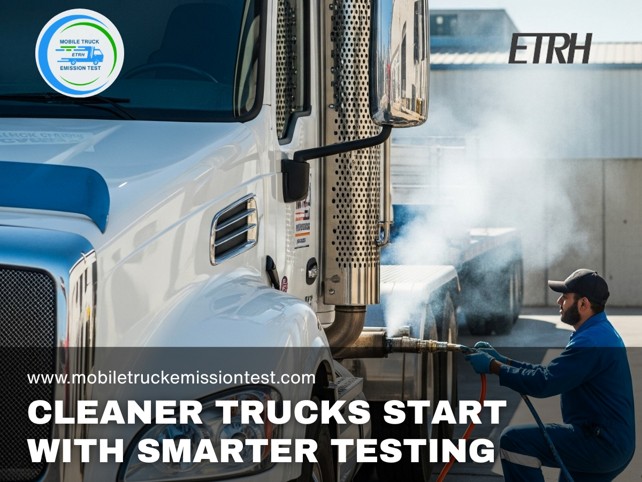
Mobile Truck Emission Test offers on-site commercial vehicle inspection service, so you can find out about issues before they become registration problems. Our technicians handle the full commercial vehicle inspection on-site, covering opacity and OBD diagnostics without pulling your truck off a paying load. No towing, no lost loads, no last-minute scrambles. Just a clean inspection on your schedule.
Comments